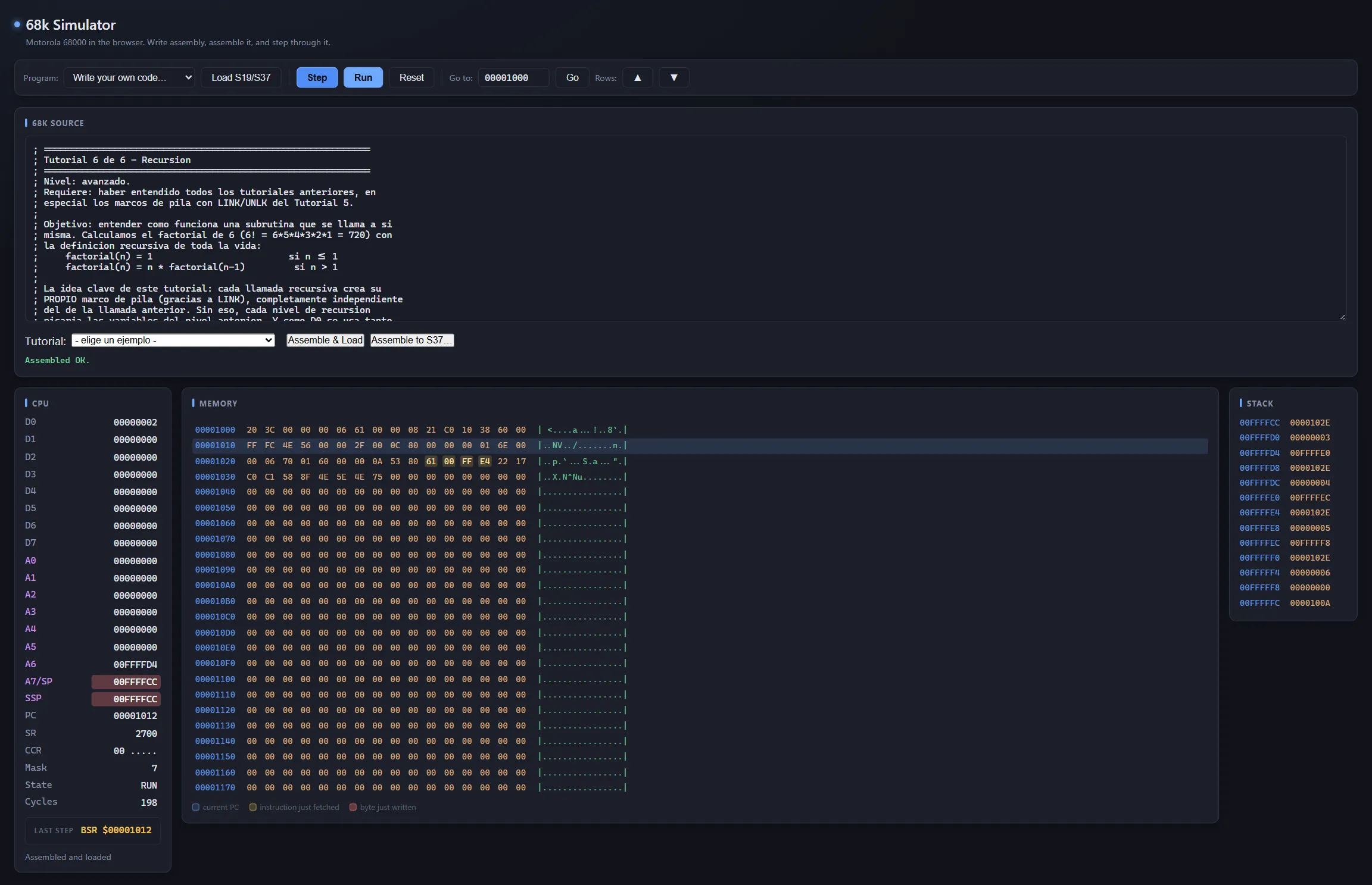
A functional Motorola 68000 emulator, with its assembler and debugger, all running in the browser with nothing to install and no server. You type assembly into the page, press Assemble & Load and step through your program one instruction at a time while you watch how the registers, the memory dump and the stack update live.
- 64 instructions, 108 mnemonics counting the Bcc, DBcc and Scc families
- 14 addressing modes, with their encoding
- 203 unit tests and 3 browser ones
- 6 tutorials of increasing difficulty
- 0 runtime dependencies
The origin of the project
In a university course we learned the 68k assembly language and tried it out in a simulator and on a real CPU in the lab. Unlike high-level languages, what is interesting about assembly in my opinion is how close it is to machine code, the next thing to ones and zeros that we humans can understand. It is a huge change to be able to see how the data and instructions of programs change in memory.
So I started writing a simulator, beginning with just an HTML table layout, with the registers on one side and the memory on the other, so that when an instruction ran you could “see” how it modified the memory. I had previously tried the Easy68k simulator and set out to make it in JS/TS so I could open it in a browser anywhere.
What it does
- Write and run your own code. The editor assembles in place. Errors come back with their line number, and nothing is loaded until the program assembles cleanly.
- Step or Run. Step executes one instruction, Run keeps going until a
STOPor a halt. The “Last step” panel disassembles what was just executed, the registers that changed are highlighted, and so are the memory bytes just written. - Watch the stack. A live stack panel, which is what makes subroutines and recursion easy to follow.
- Six tutorials, from immediate values and registers up to
DBccloops, arrays, subroutines, stack frames and a recursive factorial, each commented line by line. - S-records in and out. Load an existing S19 or S37 file, or assemble your source down to one.
Uses of AI in this project: automated tests -> finding bugs -> fixing code -> documenting and explaining me why.
| MULU / MULS | The encoder read the destination from the first operand and the source from the second, backwards from every other two-operand instruction. MULU D1,D0 silently multiplied into the wrong register. |
|---|---|
| A7 in supervisor mode | Address register handling read and wrote A[7] directly, but in supervisor mode the active stack pointer is the SSP. Anything using SP as an ordinary addressing register touched a phantom slot that nothing ever read back. |
| Strings in DC.B | The size calculation miscounted the bytes in a string literal, so every label after it landed at the wrong address. The program assembled without a single error and then ran into nonsense territory. |
| Operand splitting | Splitting on commas ignored quotes, so DC.B 'Hola, 68000!' came apart in the middle. |
| Labels named after mnemonics | A label written SUB: was parsed as a SUB instruction. |
The tests originally ran with QUnit in a browser tab, which meant npm test opened a window and
exited successfully no matter what happened inside. They now run with Vitest in Node, in about one
second, with an exit code that means something, and three Playwright tests drive the actual page so
the UI is covered too. CI runs both on every push, and the site deploys from that same workflow.
What is not there
The 68230 PI/T is documented in the repository but never got implemented, so the interrupt-driven LED
example assembles and runs while its peripheral addresses behave as ordinary RAM. DIVU and DIVS
are missing, and with them the BCD instructions, CHK, TRAPV and CMPM. Cycles are counted but
approximately: this is a functional emulator, not a timing-accurate one.
Conclusion
The project is not finished and I will surely keep updating features, fixing bugs and maybe improving the style design :). I found it a sweet irony to use a high-level language to simulate, in a browser, the assembly language of a CPU from over 40 years ago.
Areas:Electronics and low level
Link to project page: Jonamarti/68ksim
Link to the app: 68k Simulator